Friday, February 17, 2012

Translucency and the Blue Dun Sakasa Kebari


Blue Dun Sakasa Kebari

Translucency.....it's a visual characteristic that many aquatic insects display at some stage of their development.  It's also something many fly tiers try to emulate in their creations to fool hungry trout.  Translucency is the ability of a material or substance to allow light to pass through it but in a diffuse manner (it's not the same as transparency).  An insect with air bubbles or one that is shedding it's nymphal shuck will usually display some sort of translucency and this will act as a trigger for trout in some circumstances.  This principle is laid out very well in Gary LaFontaine's book on caddisflies.  He uses antron fibers to mimic this quality in his flies but others have explored other materials as well.  When held up to the light, Fran Better's Usual, with it's snowshoe rabbits fur, also displays translucency.  Many other synthetic materials have been used as well.  However, many years ago these materials may not have been available to the angler and he or she had to look elsewhere to simulate this property.  Many anglers who tied North Country Spiders created the effect of translucency by very thinly dubbing their flies with mole or muskrat fur.  In combination with Pearsall's gossamer silk thread, mole/muskrat dubbing "softened" the color of the silk thread underneath and gave the illusion of a an insect about to leave it's exoskeleton.  I love experimenting and using new materials to explore the possibilities of creating translucency in my flies but I always prefer to use natural materials when possible.  That being said, I'm posting another pattern for those who may be interested in "new" or "old" ideas.  The Blue Dun Sakasa Kebari is essentially the same as the Blue Dun listed in Sylvester Neme's book "Two Centuries of Soft Hackled Flies" with the exception the the starling hackle is tied "sakasa" style and not the traditional way with the hackle pointing to the rear (recipe is listed in the "Fly Box page").  It's a simple tie and with the added dubbing might just add a little something extra to your fly.

Tuesday, February 14, 2012

What Can You Say?


"Northern Lights"
I enjoy tying flies and if you are a frequent visitor to my blog, you already have a good idea of what my favorite kind of fly is to tie (sakasa kebari...in case your not a frequent visitor).  But the fact is there are so many other patterns of flies that have interesting histories or present certain tying challenges or are just beautiful to look at.  Among one type of flies I have become enamored with are the streamers, specifically those in the Rangeley style created by Carrie Stevens.  There are some notable tiers out there still tying these "heritage" patterns but for the most part it seems there are far too few individuals creating new patterns in this classical style.  Fortunately, for those who enjoy fishing or tying these streamers, I know of a fellow blogger who's creativity when it comes to these flies is worth a second, third and fourth look. 


"Shenandoah"
Alan, of "Small Stream Reflections" , ties some of the most creative and beautiful streamers out there.  The streamers pictured above are two of the latest that I have managed to acquire through a "mini-swap" with Alan.  I sent him several of my own flies, mainly sakasa kebari, in exchange...but I dare say I made out better in this deal.  This is the second time I have swapped with Alan and want him to know that I appreciate it.  His blog is outstanding and in it you can find these patterns as well as many other classic streamers.


From left to right..."South Bog, Shenandoah, Northern Lights, and Poudre Canyon Special"


Monday, February 6, 2012

The February Red....Sakasa Kebari


The February Red Sakasa Kebari
I had just finished tying up a bunch flies for The Tenkarabum, the other night, when the urge to do a little experimenting hit me.  Sometimes, when I place an order for tying materials I frequently use, I get "a little something extra" to play with.  A while back I picked up some peacock sticks that were dyed red because I thought the herl might add some sparkle to a new fly.  I was a little tired so I thought I would tie something simple.  The resulting fly is the one pictured above.  I call it a February Red Sakasa Kebari simply because it's predominantly red and I tied it during February (it's not related to or based on older flies in fly fishing literature with the name Feb. Red).  Besides the hook, it only consists of a hackle of starling, a body of red peacock herl and red Pearsall's gossamer silk thread. It's simple to tie and will hopefully be effective when I take it out for a "test drive" this spring.  For anyone interested, I will post the recipe on the "North River Fly Box page".

Sunday, January 29, 2012

Somerset, NJ

Daniel Galhardo giving a tenkara demonstration at The Fly Show in Somerset, NJ
Today was a day of firsts for me.  First off, I found out several weeks ago the Daniel Galhardo, founder of Tenkara USA, was going to be at The Fly Fishing show in Somerset, NJ.  This show is billed as the largest fly fishing expo in the world and I believe it.  The isles of vendors, outfitters, fly tiers, etc. seemed to stretch forever.  This was the first event of this kind I have ever attended.  I was primarily interested in meeting Daniel in person for the first time and several other tenkara anglers and fellow bloggers I have only "spoken" with through e-mails.  Among them were Morgan Lyle (who actually only lives about 15 miles from me), Tom Sadler (of Dispatches from the Middle River) .  Chris Stewart the "TenkaraBum" was also there helping to man the Tenkara USA booth and provide some friendly advice and tips to the constant flow of curious anglers who stopped by.


 I have come to enjoy blogging and exchanging comments with many of these anglers but nothing beats the being able to tell fishing water stories and discuss ideas related to all aspects of the sport.  I have become primarily a tenkara angler (but do still fish in many other ways). In addition to checking out all of the tenkara related items I did spend a fair amount of time visiting the various celebrity fly tiers (because tying is one of my other obsessions).  One such tier I was eager to meet was Don Bastian.  Don ties some of the most beautiful heritage fly patterns you will ever come across.  I have been a fan of the classic wet flies he ties for some time.  While at the show I purchased the Carrie Stevens pattern he tied pictured below.

A Don Bastian tied fly
Over all, it was a very good day and I do believe I will be making the trip to Somerset again next year.  But I did cut the day a little shorter than maybe I would have done but I had two little "snow" angles to get back to.  Unbelievably, the oldest angel will be turning 6 on Sunday.  It's funny how fast the day went but it didn't seem to go as fast as 6 years for my little girl.

My two "Snow angles" during the last, and so far only snow fall this year.  The Birthday girl is on the left.


Tuesday, January 17, 2012

The C. S. Special


The C.S. Special
This is a fly I have wanted to tie for some time now.  The inspiration for it comes mainly from another tenkara angler...Chris "TenkaraBum" Stewart.  On his site Chris has routinely touted the ability of the Killer Bug (a Frank Saywer creation) to catch trout.  In addition, Chris introduced other tenkara anglers to his own creation, the Killer Kebari, during the first Tenkara USA fly swap.  The Killer Kebari is essentially the Killer Bug with a rear facing brown hackle.  I have done well with both flies and have even managed to pick up a couple of fish with them I never expected to catch on a fly (namely a shad and yellow perch).  The common component in all of these flies is the yarn body.  Though I don't posses the Chadwick's wool used in the original Killer Bug, I tie mine in a similar way as Chris Stewart does, using Shetland's spindrift wool (color:sand with further coloring using a prismacolor sand colored marker).  When wet this yarn body is wet it really gives the fly a translucent appearance, which is appealing to a lot of fish.  I have tied the hackle of this fly in the style of a sakasa kebari and added a peacock herl collar for some extra flash.  I think all of these components together make for an effective fly and I can't wait to try it out this coming season.  For those who may be interested I will post the recipe on the North River Fly Box page.

Sunday, January 8, 2012

A Tenkara Survival Kit


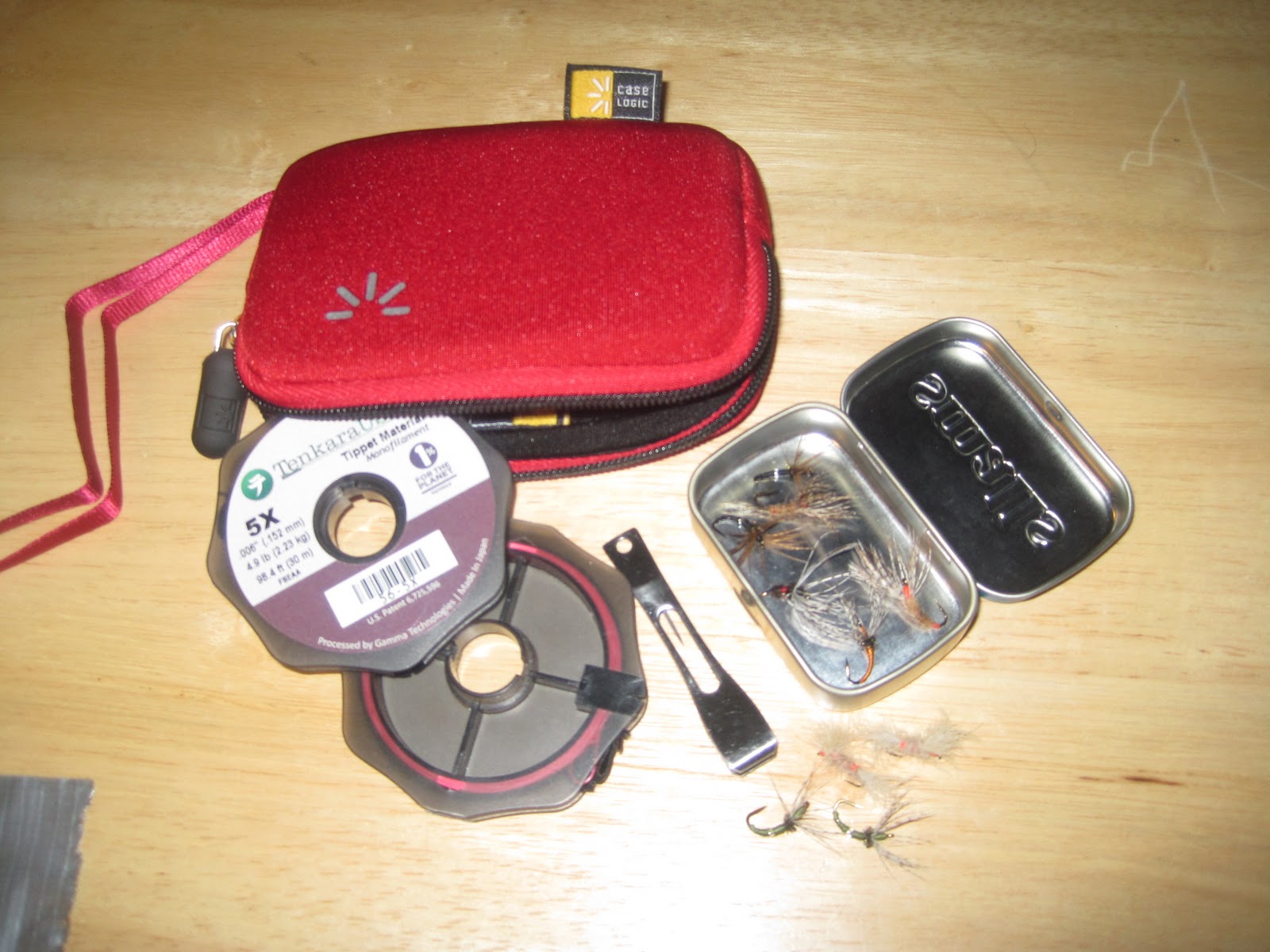
A Tenkara Survival Kit
I'm kind of an organizational neat freak.  Always have been, always will be.  I love to find ways to make small compact  kits for any purpose such as survival, first aid, hobbies, etc.  My ideal container for constructing these kits are Altoids tins of various shapes and sizes.  In addition, I sometimes like to use old camera or eyeglass cases.  The main requirements for whatever kind of kit I may be making is that it has to be functional, small, and portable. One of the last kits I made was a portable fly tying kit from an Altoids tin that would allow me to tie sakasa kebari and other flies where ever I might find myself.  One of tenkara's main appealing characteristics is it's simplicity.  In keeping with this mode thinking I decided I wanted to come up with the smallest and simplest tenkara fishing kit possible that would allow an angler to have everything needed for an afternoon out on the water.  It would be a "survival kit" of sorts.

After some consideration the kit pictured above is what I came up with.  I originally wanted to use a Altoids tin but I couldn't quite get the necessary components to fit right without a lot of modification or constructing new parts to fit them into the tin.  I happened upon the red case above at some office supply store the other day and thought it would be handy.  It's slightly larger than an Altoids tin but would still easily fit into a pocket.  I can also fit in all the necessary components for a day of tenkara fishing.  These components would include a spool of 5x tippet, a pair of nippers for cutting line, a small Altoids tin for holding 12-20 flies, and another old tippet spool to hold my tenkara level line. 


Normally, I use a BW sports bag that my wife got for me for all of my tenkara needs.  I will still use this bag because it holds more flies, fly lines, hemostat, and many other things I always use.  But in a pinch I can have this kit with me anywhere any time, as long as I have a rod with me. 

Size comparison between BW sports bag that I normally use and my new Tenkara Survival Kit

Side profile of the two kits
Over the last couple of years I have seen some interesting ideas, in terms of simplifying tenkara gear for a day out on the stream.  This is my contribution and I hope some other anglers out there may find this useful.  Even if it's not adopted by many I like the "challenge" of making such little kits and am sure it will come in handy some day. 

Tuesday, January 3, 2012

The Magnificent Moose


Moose Antler Tenkara Line Holder
The moose is one of my favorite animals.  I have only seen one in the wild once but it left a lasting impression on me.  The sheer size and power of the moose is awesome and I have always been fascinated by it.  I have found it's hair useful in tying a number of fly tying patterns.  But long before I became obsessed with tenkara fly fishing and fly tying I had a number of other hobbies.  Among these hobbies were flintknapping (making stone arrowheads using traditional techniques), scrimshaw (using 20,000 year old mammoth ivory), and antler carving.  I especially loved carving with moose antler because of beauty and structural characteristics of it (the biology of antlers is a fascinating subject all by itself).  I have pretty much dropped these other hobbies in favor of fly tying and fishing.  However, I still have some moose antler and ivory left over and am always trying to find a use for them.  Lately, I have been playing around with the idea of creating some tenkara line holders.  Even though tenkara anglers do not use reels there is still a need for line management, specifically line storage.  So I thought why not try and create a line holder with one of my favorite materials.


Moose Antler Line Holder with a Royal Sakasa Kebari and TenkaraBum Hi-Vis Level Line
I think it came out OK.  I tried to add a few features to make it useful.  For example I added a little "nub" to hold the loop of fly line that attaches to the lillian on a tenkara rod.  There is also a hole to hold the fly.  The only drawback to it is it's size.  It's only about 2.25 inches in diameter, which is a little on the small side.  The problem is trying to find a slice of antler from the stem that has a large diameter but at the same time is made of dense and not spongy bone.


A "Loaded" Line Holder
In the end, whether it's used or not there is certain sense of satisfaction in creating your own fishing equipment.  I have definitely derived a lot of joy from tying my own flies.  I think I could get into making more than just flies.  Now if I could only find a good sized piece of that mammoth I have somewhere.  A 20,000 year old line holder would be really cool!